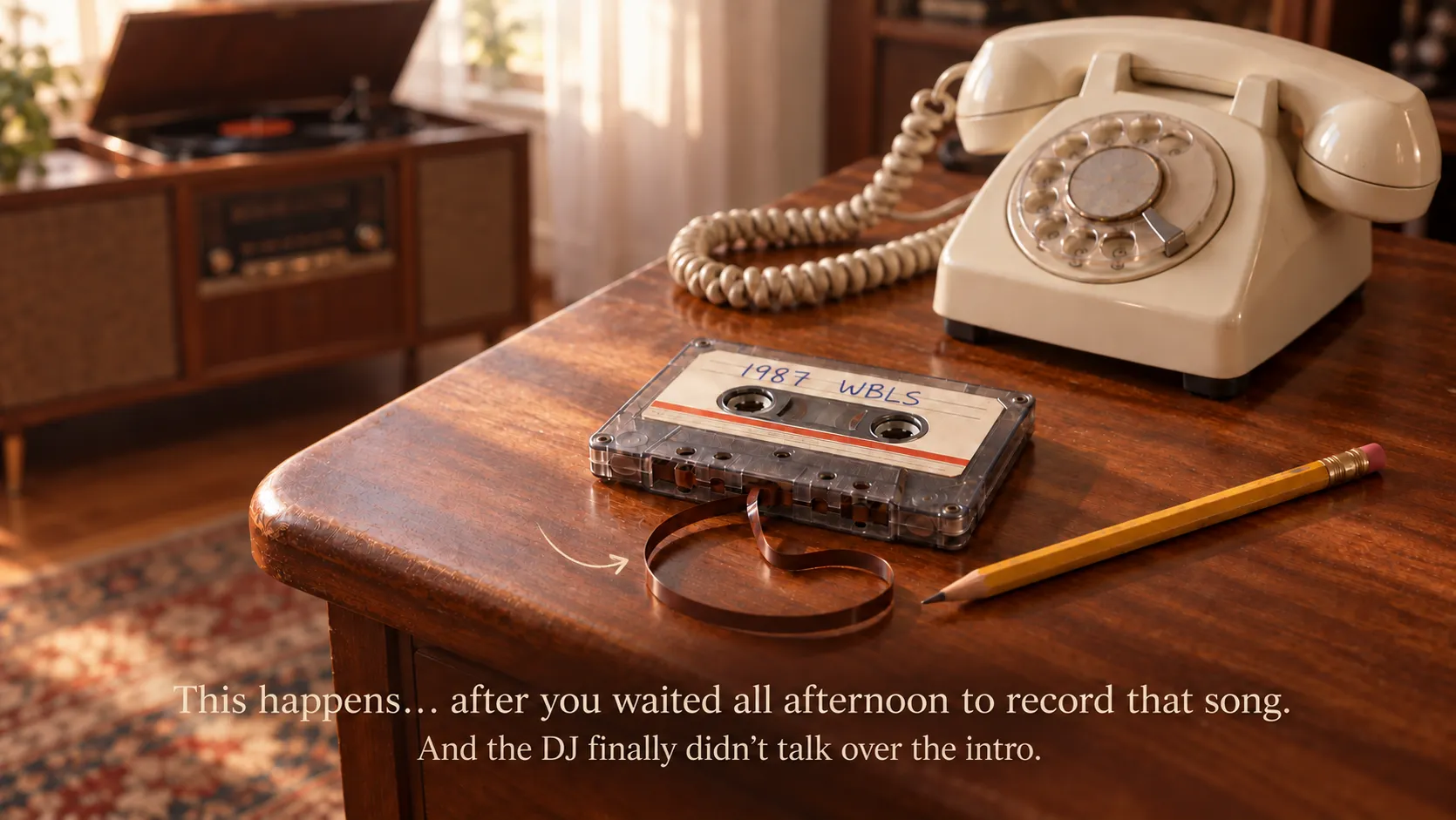
There was a time when a pencil was an essential piece of music equipment.
Anyone who grew up with cassettes probably knows why. When the tape came loose, a pencil in the spool and a little patience could get the music going again.
I grew up with records at home and an eight-track in the car. Then came cassettes, CDs, and eventually an iPod. Music that once required shelves, cases, and equipment could fit in a pocket. Now, asking for a song out loud can be enough to make something in the room play it.
Somewhere along the way, that became more than normal. Anything else started to feel abnormal.
The phone used to have a place in the house. Making a call meant going to it, and privacy depended partly on how far the cord would stretch. One wrong number near the end of a rotary dial meant starting all over again. Getting it right usually took several tries.
Leaving the house meant planning before heading out, instead of figuring everything out along the way. Making a call required finding a pay phone, having change, and either remembering the number or carrying that little black book.
Typing class used a typewriter. I still remember the typewriters in shows like Barney Miller and Hill Street Blues, and people smoking right at their desks. That was office culture then. At home, watching Saturday morning cartoons meant sitting in front of a television that was an actual piece of furniture.
None of it seemed slow or behind the times. It was just life.
Those things belong to the past now, but they were also part of what progress looked like. The future kept arriving. Quite often, it came with a cord.
Sometimes, I still long for the simplicity of life then. Was life really simpler, or was that just what we were used to?
At the same time, there’s no desire to go back to carrying a checkbook, making more frequent trips to the bank, or needing an entire stereo system, tape deck, VCR, and floor speakers. The lights coming on because they know I’m close to home, or groceries arriving without another trip to the supermarket, are conveniences I don’t want to live without.
Apparently, my nostalgia has limits.
Professionally, the changes in media and marketing have been just as striking. TV spots, direct response, catalogs, and mail order were familiar ways to reach customers. Buying something often meant going to a store, making a phone call, or mailing in a form. Businesses had customer information, but the amount available and how it could be used were very different from today.
Now, a search or a visit to a product page can lead to related advertising showing up elsewhere. That can feel intrusive, but it can also be convenient. Something relevant shows up, ordering takes a few taps, and it arrives at the door. It’s easy to have mixed feelings while still appreciating how much easier the process has become.
Culture evolves as technology does. The equipment changes, and then the expectations follow. Being reachable becomes normal. Getting an answer immediately becomes normal. Waiting starts to feel like something has gone wrong.
AI brings more of that convenience. I use it for speed and efficiency, and it even helped edit this article. But after decades of technological change, this is the first time I’ve felt a little fearful about what I might forget.
There’s a less polished way to put it: is this making me stupid?
Is this making me stupid? What happens to our command of grammar, mathematics, and logic when there’s less need to use them? Or our ability to remember facts? Some skills once felt like second nature. With help so readily available, I wonder whether they’ll still come as naturally when that help isn’t there.
There are changes that seem easy enough to accept. Memorizing fewer phone numbers doesn’t particularly bother me. Being less able to work through a problem, explain the reasoning, or recognize when an answer doesn’t make sense feels different. The time saved is valuable. So is knowing how to get to an answer and understanding why it’s right.
“I’ve told my grandchildren, ‘First you learn how to work the problem, and then you can go use the computer.’”
For younger generations entering the workforce, these tools are already becoming part of everyday life. They’ll bring different strengths and expectations, just as earlier generations did. Still, it raises questions about which skills remain essential and how they develop when technology can do so much of the work. It’s hard to know where reasonable adaptation ends and losing something valuable begins.
Some of this concern may be nostalgia. Some may reflect a meaningful difference in what technology is now able to do. I don’t have the answers, and I’m not ready to form a firm opinion. The convenience is welcome, yet the uncertainty hasn’t gone away.
For now, I’m rolling with the punches and enjoying what technology makes possible, while being conscious of the potential impact. The question of what we might forget along the way is still there.
I’ll leave you with that to think about.
Written by Ladell Fuqua. AI tools assisted with editing.